Showing posts with label literature. Show all posts

Sunday, July 8, 2012

50 Shades of Fanfic

I don't think I am going to read the current literary craze that has housewives the breadth of the country cackling with delight over how sexy it is.  No matter how many people tell me that 50 Shades of Grey is the best thing since Harry Potter slash fan-fiction. Actually, 50 Shades is Twilight slash fiction isn't it, because that's where author E L James started out ?


 You haven't heard of of slash fanfic ?


Supernatural - you'll never see the Winchester's in the same light
once you have encountered Supernatural slash-fiction.


Well, there is fan fiction - stories written by fans of a particular novel or series of novels which place existing characters in new situations and plots. Some of it is good, much of it is dross. Then you have slash fiction which began as homosexual pairings of literary characters - Frodo buggers Sam, Legolas gives Boromir a blowjob etc. - and has now broadened to become a wider erotic genre encompassing heterosexual relationships and other, stranger pairings. Stranger pairings you say ? Well yes, Lord of the Rings has Ents, and Harry Potter has house elves, and their crazed slash-fic fans don't like to let any possible match-up go to waste.

Tuesday, May 1, 2012

Free Books

I saw this website posted in one of my university groups...

Real Readers

Keen readers who are willing to write reviews can apparently get free books, in advance of publishing, to read and review.  It sounds good so I have registered with them.  I will report if and when I get my first free books.

Friday, April 27, 2012

A Poverty Of Contemplative Thought ?

"Over the last 100 years or so the loss of the religious as a reputable discourse in common life has led to a poverty of language, and thus to a poverty of contemplative thought and feeling about what we are, and what we need. We need some inner stuff, scaffolding to help us get around our inner space, something to help us map, explore and even settle those places where we are still primitive." - Jane Davis in the essay The Reading Revolutiuon in Vintage Books' Stop What You're Doing And Read This, London, 2011.


The Reader Organisation

Monday, April 23, 2012


"Local libraries are gateways - not only to other libraries but to other lives" Zadie Smith in Vintage Books' praise of prose Stop What You're Doing And Read This.

Wednesday, April 4, 2012

Book Review: Reality Hunger - David Shields 2*


The cover lines for Reality Hunger read "Is the novel dead ? Can You copyright reality ? Is art theft ?". All good and interesting questions which I was hoping Shields was going to demonstrate his arguments in a clear and informative fashion.

Instead, he has chosen to 'illustrate' his points, or mostly point singular - how much he detests the narrative novel form - by constructing his book from hundreds of quotes, each presented without reference or context apart from appearing under headings such as reality, mimesis, genre and persona.  What at sight of the cover looked to be an engaging and thought provoking read soon turns into a tedious grind of wading through hundreds of short texts supposedly linked to the chapter heading Shields has dreamed up but often having only the most tenuous of connections.

Perhaps I should construct the review along similar lines to the book by giving you two of the quotes...

359 - "Nonlinear. Discontinuous. Collage-like. An assemblage. As is already more than self-evident."

362 - "Nothing is going to happen in this book."

Wednesday, March 14, 2012

Eye Candy (For The Ladies)

Ok, so I post quite a lot along the lines of Hot Rock Chicks and Olympic Babes, so how about some sizzling hot literary eye candy for the ladies.  May I present the red hot Russian dramatist and author Anton Chekov...


Anton says he creates a submerged life in the text, he's a friend of Leo Tolstoy and has his own dacha.
He's also unfortunately most definitely dead (1860-1904)

Thursday, February 23, 2012

What I Did On My Holidays


The Moonlit Mind - Dean Koontz 6*
The New Rules - Bill Maher 9*
Mockingjay - Suzanne Collins 7*
Catching Fire - Suzanne Collins 7*
The Hunger Games - Suzanne Collins 8*
Snuff - Terry Pratchett 8*
The Four Horsemen Of The Apocalypse - Vicente Blasco Ibanez 8*
Soldiers Of Salamis - Javier Cercas 4*
127 Hours - Aron Ralston 9*
VSI Sikhism - Eleanor Nesbit 7*
Tiger, Tiger : A Memoir - Margaux Fragoso 8*
On The Third Day - Rhys Thomas 7*
The Good Women Of China : Hidden Voices - Xinran 9*
Songs Of The Mexican Seas - Joaquin Miller 4*
Blackout - Connie Willis 3*
Antique Works Of Art From Benin - Augustus Henry Lane-Fox 8*
The Man Who Would Be King - Rudyard Kipling 7*
Miss Peregrine's Home For Peculiar Children - Ransom Riggs 7*
The Insatiable Spider Man - Pedro Jaun Gutierraz 6*
Band Of Brothers - Alexander Kent 4*

    Friday, January 13, 2012

    "...the governor of the region had suffered a rush of blood to the head a month or so before: he'd launched a crackdown on corruption, annoyed someone in the interior ministry, and shortly afterwards had been found dead in the banya at the bottom of the garden.  It was suicide, Steve explained, at least according tot he prosecutor's office and the local newspapers.  The governor had shot himself in the head - twice." A D Miller, Snowdrops.
    "I said, didn't she mind that the people in charge seemed to spend half their time stealing ? Yes, she said, of course she minded, but there was no point putting new people in the Kremlin, because they'd just start the stealing all over again.  At least the ones in there now were already rich, so they could afford to think about other things too sometimes." - A D Miller, Snowdrops.

    Friday, January 6, 2012

    The Books I Enjoyed Most in 2011

    I was going to a best books of the year list, but since taking on the degree work and simultaneously trying to work through the 1001 list, I have read precious few novels in the year of their publication.  Here instead then are the books that gave me the most reading pleasure last year.

    One Flew Over The Cuckoo's Nest - Ken Kesey 10*
    Quite wonderful, highly enjoyable, both laugh out loud funny and achingly sad, Kesey's best known novel is a near perfect work.

    Address Unknown - Kressman Taylor 10*
    A Jew betrayed by his German-American business partner sets about gaining a measure of justice, or revenge, in a cunning literary manner.  Published on the eve of WWII, Taylor's novel was banned by the Nazi's.
    
    Cover of "The Burial at Thebes"
    Cover of The Burial at Thebes
    

    The Burial At Thebes (Sophocles Antigone) - Seamus Heaney 10*
    Long poem or short novel in the style of a poem ? Heaney's translation is flowing and exciting.  He has a most special gift for language.
    

    Appreciating Art - Diana Newell 10*
    I bought this to help on my pre-degree course and what an excellent guide it is.  Newell explains clearly, and with lavish illustrations and reproductions of famous art works, how Western Art and painting in particular has evolved from 1400 t the present day.

    Attention All Shipping - Charlie Connelly 9*
    Radio 4 and the Shipping Forecast are two small parts of what makes the British British.  Connelly explores the physical areas of the Shipping forecast, encountering the people who live in or by them, and uncovering a trove of fascinating shipping and weather related lore.

    Surface Detail - Iain M. Banks 9*
    
    Hell is real if you believe in it, or rather if your culture wants or demands it.  Banks has a serious look at one aspect of belief in amongst giant space ships with weird names, death and technological resurrection and a a world sized weapons factory that might threaten known space.  Banks' Culture novels are still the cream of contemporary space sci-fi.


    The God Of Small Things - Arundhati Roy 9*
    Roy's complex weaving of the lives of a Indian family, told largely through the eyes of one of a pair of twins takes in diaspora, love, passion, the changing political landscape in India and has always at its heart a terrible tragedy that is hinted at in the earliest pages but only is only truly made clear as the novel draws to a close.  Intelligent, passionately enthralling and brilliantly conceived, Roy shows deep understanding of all the many kinds of love.

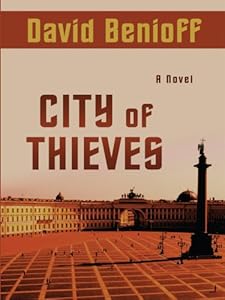
    City Of Thieves - David Benioff 9*
    
    Cover of "City of Thieves (Thorndike Pres...
    Cover via Amazon
    
    Two men fall foul of the Communist authorities in besieged Stalingrad and are sent on a bizarre mission to find a dozen fresh eggs for a wedding cake.  It sounds bizarre, but Benioff makes his idea work beautifully.  Yes it is really about the horror of war and man's inhumanity to man, but there is scope for friendship and laughter amongst the bleakness of life in a city at war.

    Under Fire : The Story Of A Squad - Henri Barbusse 9*
    Translated from the French, this really is the horror of.  Barbusse holds nothing back as he describes the living hell the French troops endured in the trenches of WWI, all based on his own experiences as a soldier. 

    Doctor Faustus - Christopher Marlowe 9*
    Was Marlowe a better playwright than Shakespeare ? Faustus certainly shows him as a man with of inventive, acerbic wit and a sharp turn of phrase.

    The Great God Pan - Arthur Machen 9*
    Classic horror, pre-Lovecraft and very much of the same style that H P would later employ.  Only really a novella, but well worth searching out.  Stephen King says it is perhaps "the best horror story in the English Language."

    Terra : Four Events That Changed The World - Richard Hamblyn 9*
    Hamblyn takes us on a tour of almost apocalyptic natural disasters, always emphasising the human cost.  The section on the Lisbon earthquake - which was followed by firestorm, aftershocks and tsunami - is particularly gripping and well written.

    The following were also excellent...
    Lord of the Rings Trilogy - J R R Tolkein 10*
    Three Men In A Boat - Jerome K Jerome 9*
    AA100 Reputations - Ed. Elaine Moohan 9*
    Making Sense Of The Arts - OU Course Team 9*
    The Time Machine - H G Wells 9*
    Of Human Bondage - W Somerset Maugham 9*
    Ilkley Revisited - Mike Dixon 9*
    The Storyteller's Tale - Omair Ahmad 9*
    VSI English Literature - Jonathan Bate 9*
    A Month In The County - J L Carr 9*
    A Christmas Carol - Charles Dickens 9*
    The Graveyard Book - Neil Gaiman 9*
    Forgotten English - Jeffrey Kacirk 9*


    Enhanced by Zemanta

    Wednesday, January 4, 2012

    "Philip was a good listener; though he often thought of clever things to say, it was seldom till after the opportunity to say them had passed;" - W Somerset Maugham, Of Human Bondage.

    Book Review : Ulysses - James Joyce 2*

    
    Announcement of the initial publication of Uly...
    Image via Wikipedia
    I realise that Joyce's stream of consciousness work is endlessly inventive and clever, displaying a dazzling use of language and a lack of repetition which is quite incredible for a a book of its size and length.  However, call me an old traditionalist if you will, but I would have sacrificed several hundred pages of bizarre literary ramblings for anything bearing a resemblance to a coherent narrative.  Ulysses took me almost six weeks to read, in stages as I could not stand the though of grinding through more than a handful of pages each day.

    David Punter, English Professor at Bristol University describes Ulysses as "one of the most extraordinary works of literature in English."  Punter goes on to praise the manner in which Joyce performs "an exploration of the inner workings of the mind" and Joyce's replication of random thought processes.  I can see all this, and I do admire it in a way as being original, groundbreaking and inflammatory.  For myself though, none of these things made Ulysses into an interesting or compelling read.
    Enhanced by Zemanta

    Tuesday, January 3, 2012

    Library Raid

    Cover of "Wolfwatching"
    Cover of Wolfwatching
    A large haul as I'm expecting it to be rather quiet in the next few weeks....

    Cathedrals in Britain and Ireland - William Anderson & Clive Hicks

    The History of Christianity - Jonathan Hill

    Wolfwatching - Ted Hughes

    Churches and Cathedrals - Helen and Richard Leacroft

    A Hundred Doors - Michael Longley

    English Parish Churches - Edwin Smith, Olive Cook, Graham Hutton

    Catholicism - Peter Stanford

    A Practical View of Christianity - William Wilberforce

    Sorry to anyone else in Ilkley wishing to study Christianity or church architecture, I think I grabbed the lot.
    Enhanced by Zemanta
    Cover of "Of Human Bondage"
    Cover of Of Human Bondage
    "Philip had an unfortunate trait: from shyness or from some atavistic inheritance of the cave-dweller, he always disliked people on first acquaintance; and it was not till he became used to them that he got over his first impression. It made him difficult of access. He received Hayward's advances very shyly, and when Hayward asked him one day to go for a walk he accepted only because he could not think of a civil excuse." - Of Human Bondage by W. Somerset Maugham.
    Enhanced by Zemanta

    Tuesday, December 6, 2011

    Wagner - The Greatest Hoax

    
    English: W. Somerset Maugham British writer
    W Somerset Maugham
    
    "But Siegfried! When he mentioned it Professor Erlin leaned his head on his hand and bellowed with laughter. Not a melody in it from beginning to end! He could imagine Richard Wagner sitting in his box and laughing till his sides ached at the sight of all the people who were taking it seriously. It was the greatest hoax of the nineteenth century." - Of Human Bondage, W. Somerset Maugham.
    Enhanced by Zemanta

    Tuesday, November 15, 2011

    Book Review : Swiss Family Robinson - Johann David Wyss 2*

    I was hoping that this would be more in the Crusoe vein, but it isn't, it's tripe.

    The Robinson family get shipwrecked on a bountiful coast containing a menagerie of wildlife from various continents, all of whom appear overly eager to hurl themselves on the family's hunting spears whenever they get peckish. Indeed, the life at the shipwreck point is so rich and varied that they hardly seem to eat the same meal twice.

    Within a year the family have established a system of irrigated farms, have built a number of homes, have domesticated half the animal population of the area and then bump into the natives - read; savages - of the area who have not managed to do any of these things.  The author though understands full well why the locals have not reached shipwrecked Europeans standards of living, it is obviously because as they are black / savages / natives / brown skinned, they are obviously uneducated.

    I disliked this book all the way through, every mild problem the family encounter is solved with overwhelming efficiency, almost nothing appeared believable.  If you want a decent historical shipwreck story go for Crusoe.

    Monday, October 17, 2011

    Wagner, Dead As Mutton

    Caricature of Richard Wagner Cover of L'Eclips...Image via Wikipedia
    "I tell you young people that before the nineteenth century is out Wagner will be as dead as mutton. Wagner! I would give all his works for one opera by Donizetti."
    "But Siegfried! When he mentioned it Professor Erlin leaned his head on his hand and bellowed with laughter. Not a melody in it from beginning to end! He could imagine Richard Wagner sitting in his box and laughing till his sides ached at the sight of all the people who were taking it seriously. It was the greatest hoax of the nineteenth century." - Of Human Bondage, W. Somerset Maugham.
    Enhanced by Zemanta

    Wednesday, September 28, 2011

    Is This Land The Nurse That Bred Thy Soul ?

    Seneca, part of double-herm in Antikensammlung...Image via Wikipedia
    "Declare with speed what spot you claim by birth. Or with this club fall stricken to the earth! This club hath ofttimes slaughtered haughty kings! Why mumble unintelligible things? What land, what tribe produced that shaking head? Declare it! On my journey when I sped Far to the Kingdom of the triple King, And from the Main Hesperian did bring The goodly cattle to the Argive town, There I beheld a mountain looking down Upon two rivers: this the Sun espies Right opposite each day he doth arise. Hence, mighty Rhone, thy rapid torrents flow, And Arar, much in doubt which way to go, Ripples along the banks with shallow roll. Say, is this land the nurse that bred thy soul?" - from Apocolocyntosis by Lucius Annaeus Seneca.
    Enhanced by Zemanta

    Tuesday, September 27, 2011

    Lucius Annaeus Seneca, sculpture by Puerta de ...Image via Wikipedia

    Then Hercules said, "You just listen to me, and stop playing the fool. You have come to the place where the mice nibble iron." Apocolocyntosis, Lucius Annaeus Seneca.

    Pic - Sculpture of Lucius Annaeus Seneca by Puerto De Almodovar in Cordoba.


    Enhanced by Zemanta

    Monday, September 26, 2011

    Book Review - The Underdogs : Mariano Azuela 6*

    Revolutionary camp outside Ciudad Juárez in 1911Image via Wikipedia Written about events during the Mexican Revolution, this tale follows the exploits of a group of villagers who band together under their local leader Demetrio Macias.  The men seemed to have joined the Revolution not out of ideals, but because a side has to be picked, and a poor working man has to be anti-Federal.

    Demetrio leads through force of action, but when a Federal deserter, Luis Cervantes, arrives with his city education and, initially at least, his strong sense of ideals for the Revolution, the group find they have a spokesman who can express why they are fighting.

    As the war grinds on, Demetrio's band experience some success, but along the way they become corrupted by greed and revenge.  Petty killings occur on the flimsiest of pretexts, and robbery and looting become the order of the day.  Eventually they come to be feared and hated by the peasentry in turn as the federal soldiers who burn Demetrio's home were hated by them. Cervantes uses the power of his speech to set Demetrio up as a great general, with Cervantes rising in power at his side.  The city man though can see which way the wind blows, and as the Revolution begins to turn on those people it was meant to serve, he flees the fighting with his war loot and sets himself up in business.

    When the gang eventually return home they can find no peace.  Demetrio is asked why he keeps on fighting, but after two years the fighting has come to define his life and he can see no other purpose for it.

    The Underdogs chronicles the failures of the Mexican Revolution as it turns on the very people it was meant to serve.  In its unflinching treatment of the main characters and Azuela's depiction of men changed by war and greed, it paints a picture which has become more familiar to us in more recent war books and films, particularly those concerning the American involvement in Vietnam.

    An interesting read that introduced to me a period of history I knew nothing about, but which makes clear the eternal pointlessness and brutalising nature of war.
    Enhanced by Zemanta